
Rolex Imperfections: Why Even Rolex Makes Mistakes
The Twenty-Million-Dollar Mistake
In October 2017, a stainless steel Rolex Daytona sold at Phillips in New York for $17,752,500. At the time, it was the most expensive wristwatch ever auctioned. The buyer was anonymous. The consignor was James Cox, who had been gifted the watch decades earlier by the actor Paul Newman, whose name it now carries.
Here is the strange part: when that exact Daytona left Geneva in 1968 or so, nobody at Rolex thought it was special. The reference 6239 had been ordered with what the factory internally treated as a slow-selling “exotic” dial: art-deco subdials, a contrasting outer track, blocky indexes. Christie’s and Hodinkee have both documented that the exotic dial “was not appreciated by the market at the time of its production.” Dealers couldn’t move them. Some were swapped back to standard dials at service. Rolex kept making them anyway, in small numbers, until they quietly stopped.
What was once a dial that nobody wanted is now the single most valuable configuration in the brand’s history. The story of Rolex imperfections (the tropical dials, the misprinted bezels, the off-center cyclops lenses, the bakelite that cracked) is, at its core, a story about how the most exacting watchmaker on earth still ships flaws, and how time turns those flaws into the most coveted details of all.
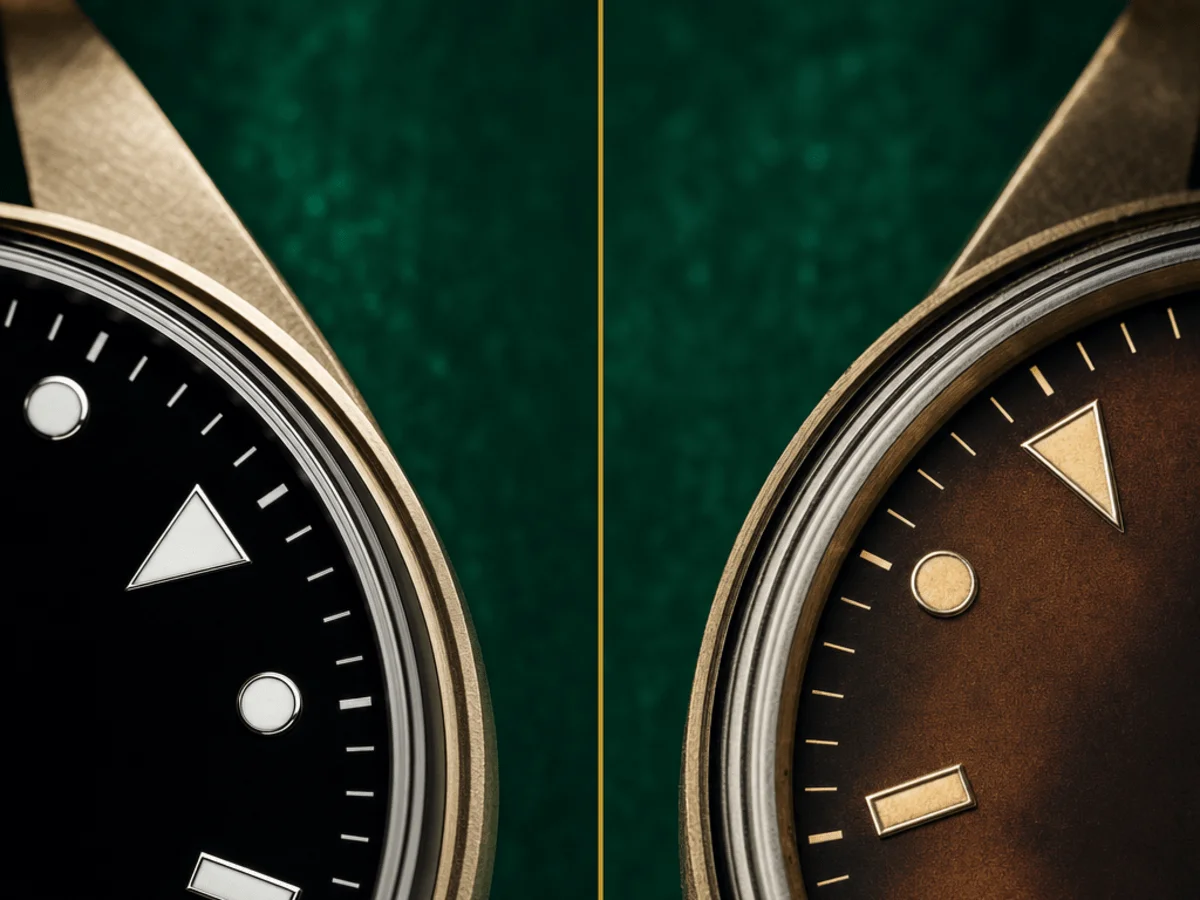
The Myth of Rolex Perfection
Rolex has spent the better part of a century building an identity around the word precision. Walk into any boutique and the marketing apparatus is unmistakable: COSC chronometer certification, the Superlative Chronometer designation, the green hangtag, the five-year international guarantee.
The numbers behind that reputation are real. Rolex’s own published standard is -2/+2 seconds per day after casing, more than twice as tight as the COSC baseline of -4/+6 seconds that an ordinary Swiss chronometer has to meet. Every movement goes to COSC first, then back to Rolex for in-house testing after it is cased. According to the brand’s official certification page, each watch is “tested twice: first by the COSC and then once again by Rolex after casing, to ensure superlative precision.”
Then there is the scale. Morgan Stanley / LuxeConsult estimates put Rolex’s annual output at roughly 1.18 million watches in 2024, on revenue north of CHF 10.5 billion, about a third of the entire Swiss watch market by value. Rolex is, by a wide margin, the largest single client of COSC, taking well over 800,000 chronometer certificates a year.
Now do the arithmetic. If Rolex ships 1.18 million watches a year and achieves a genuinely heroic 99.5% first-pass perfection rate, that still leaves roughly 5,900 watches a year with some kind of cosmetic or functional variance from the platonic ideal. Even at a fantasy 99.9% rate (better than essentially any consumer manufacturer on earth), you’d still be talking about more than a thousand Rolexes a year shipping with a thing that wasn’t quite right.
This is the part the marketing doesn’t dwell on. Rolex doesn’t make imperfect watches on purpose. Rolex also doesn’t make perfect watches, because nobody does. The Rolex movements inside those cases are extraordinary pieces of engineering, but the watches around them are assembled by human hands in clean rooms, dialed by technicians, polished by workers whose eyes get tired by 4 p.m. The parts come from suppliers and batches that vary, the way all materials vary.
Perfection is a story. Imperfection is the physical reality underneath it. And as any veteran collector will tell you, the gap between the two is where the most interesting watches live.
The Factory Floor: Where Mistakes Actually Get In
To understand why Rolex imperfections exist, it helps to picture how a watch actually comes together. A modern Submariner or GMT-Master II is not stamped out of a machine in one piece. It is the meeting point of dozens of separately produced components: dial, bezel, crystal, chapter ring, hands, lume plots, bracelet, end links, case. Each is made on its own line, each with its own tolerance stack, and all of them are mated by hand at final assembly.
Here is where variance creeps in:
Dial printing. A Rolex dial is pad-printed, essentially a fine silicone pad picking up ink from an engraved plate and stamping it onto a lacquered brass disc. If the pad is a fraction off-register, the text shifts. If the ink batch is slightly different, the color drifts. If the lacquer cures unevenly, the surface ages in unpredictable ways. This is the production line that produced the famous “Meters First” Submariner dials, the gilt Explorer dials of the 1950s and ’60s, and the red-text Double Red Sea-Dweller. All of them were originally just normal dials. All of them are now worth multiples of their standard siblings.
Bezel alignment and insert seating. The bezel is a separate ring, clicked onto the case via a spring-loaded mechanism. On vintage GMT-Masters and Submariners, the insert is glued into the ring. A small rotational drift at the factory, a slightly off-center pearl, or a bezel that clicks half a millimeter left of true north: these are the kinds of things a sharp-eyed buyer catches on delivery and a less-sharp-eyed buyer never notices at all.
Lume application. On modern Rolexes the Chromalight plots are applied as a paste and cured. Thickness, hue, and edge cleanliness vary from plot to plot and batch to batch. On vintage watches, the radium and tritium compounds aged unpredictably, turning cream, coffee, or pumpkin. That aging is now what collectors pay for.
Hand setting and dial seating. Hands are pressed onto pinions by hand. A fraction of a millimeter too low and the minute hand sweeps the chapter ring. A fraction too high and the hour hand sits awkwardly above the dial plane. A dial seated a half-degree off-center will leave the date window visibly tilted under the cyclops.
Case polishing and bracelet assembly. The Oyster case is famously over-engineered, but the finishing (the brushed lugs, the polished flanks, the bevels) is done by humans on wheels. Slightly uneven brushing is a frequent AD-delivery complaint. Bracelet end links are machined to tight tolerances but bolted to cases that have their own micro-variance, which is why “SEL gap” (solid end link gap) is one of the most-discussed Rolex imperfections on enthusiast forums.
None of this is scandalous. It is the texture of mass-produced luxury goods. What makes Rolex unusual is not that these variances exist; it is that collectors have spent fifty years building a taxonomy of them, and a market that prices them to the dollar.
Famous Factory Errors That Became Grail Pieces
The deepest pleasure of vintage Rolex is that the mistakes have names. Here are the ones any serious collector knows.
The Paul Newman “Exotic” Dial Daytona (ref. 6239)
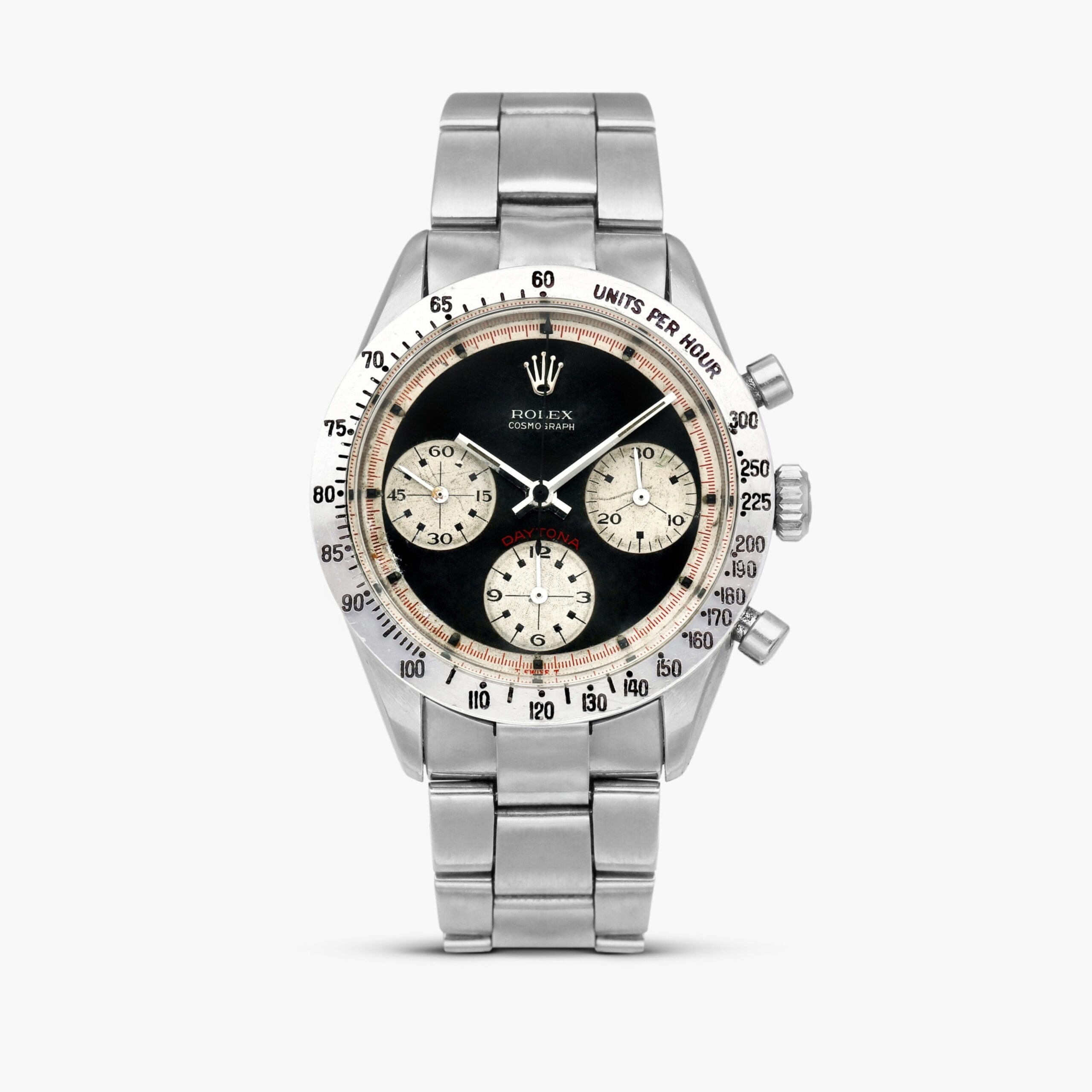
The original mistake was simply a dial nobody ordered. Rolex offered the exotic (with its art-deco subdials, square-tipped indexes, and contrasting outer track) as a catalog option on the Cosmograph Daytona starting around 1967. Buyers hated it. Production was tiny, and many of the surviving watches were retro-fitted with standard dials at service.
Then Paul Newman’s wife Joanne Woodward gave him one with an engraving on the back. Photographs of Newman wearing it at the racetrack slowly filtered through Italian collector magazines in the 1980s and ’90s. The dial nobody wanted picked up his name, and the rest is a Hodinkee Reference Points feature and a Phillips lot page worth of price history. In 2013, Hodinkee noted a standard ref. 6239 bringing roughly $28,750 at auction while a Paul Newman 6239 in similar condition cleared $93,750, more than three times the price for what was, mechanically, the same watch.
Tropical Dials
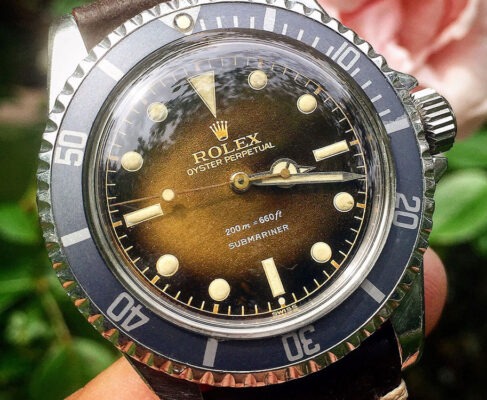
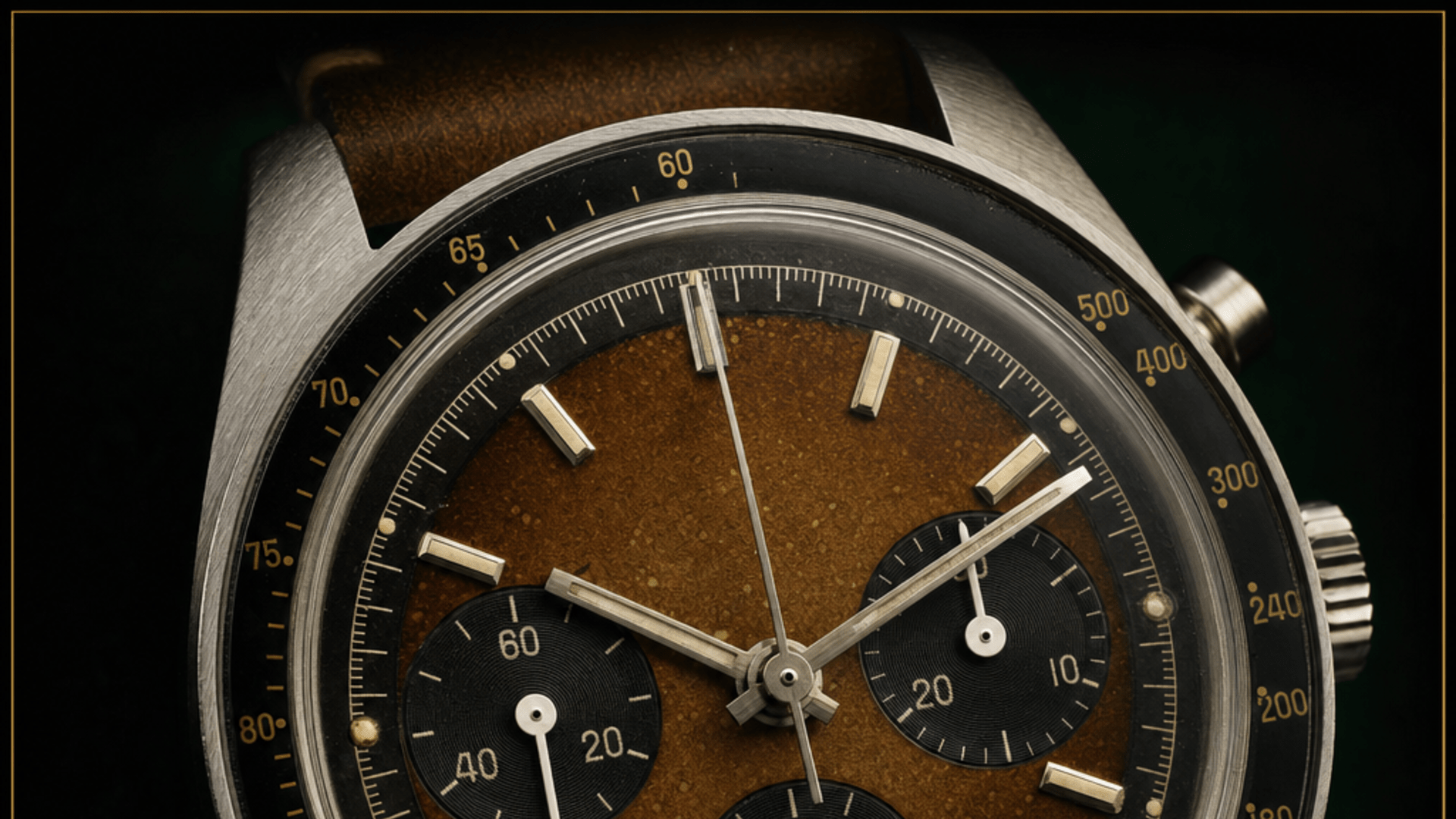
A tropical dial is, in plain terms, a black dial that has faded brown. The cause is decades of UV, heat, and humidity breaking down the lacquer and pigment. On a poorly stored watch the result is blotchy, ugly, and value-destroying. On a well-loved watch the result is an even, chocolate-to-mocha fade that no two examples share.
Tropicals are the purest expression of why Rolex imperfections get prized: they cannot be faked well, they cannot be ordered from the factory, and they are unrepeatable. A tropical vintage Submariner is worth meaningfully more than its standard-black sibling because the imperfection is the provenance.
The GMT-Master ref. 6542 Bakelite Bezel
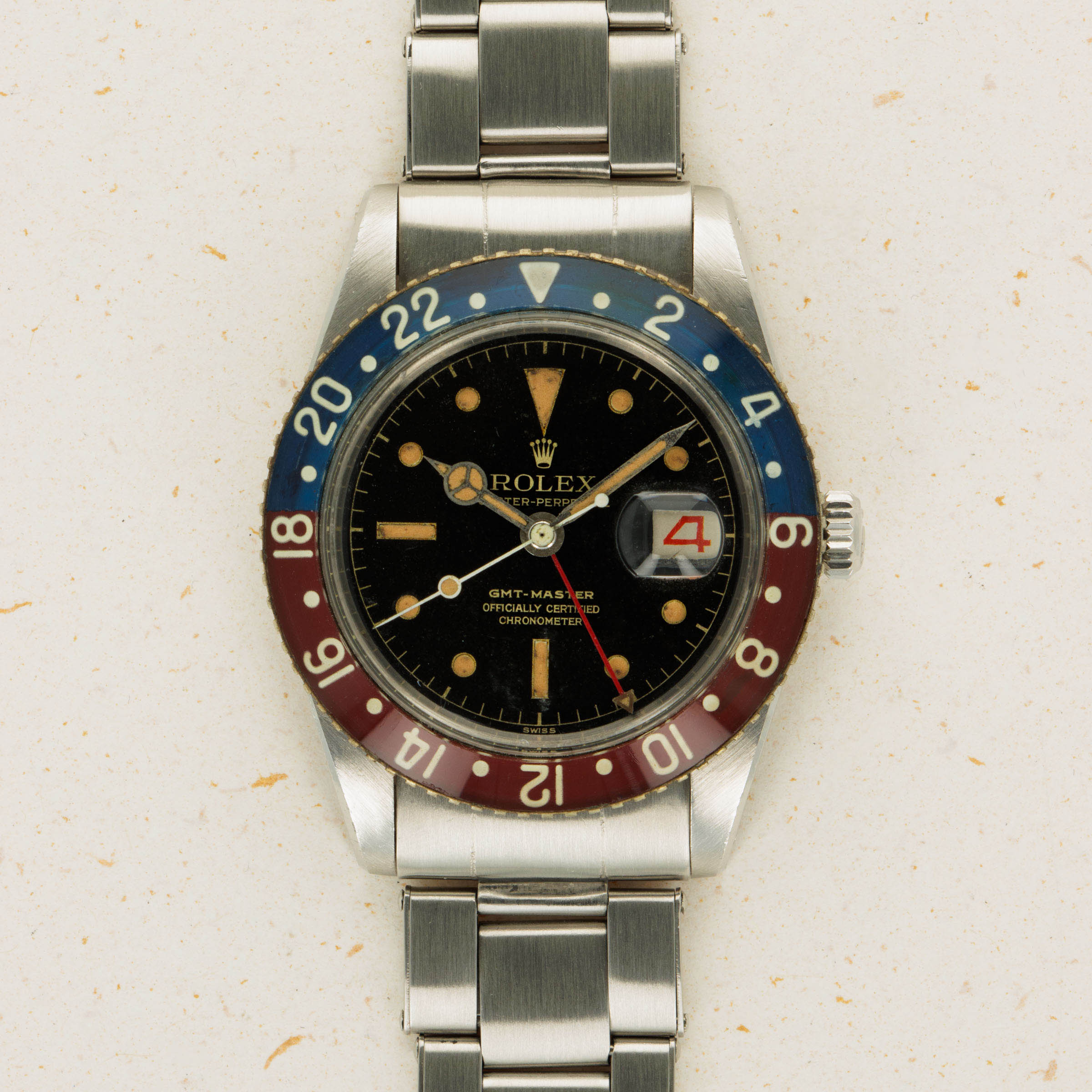
The original GMT-Master, launched in 1954 for Pan Am pilots, shipped with a translucent bakelite bezel insert with radium-based luminous numerals. It was beautiful. It also cracked under normal cockpit use and was radioactive enough that, by the late 1950s, Rolex was quietly replacing surviving examples with metal inserts during service. Original bakelite 6542s are now among the most coveted vintage Rolexes on earth. Hodinkee’s Reference Points guide to the GMT-Master and Monochrome-Watches’ GMT deep-dive both document how a bezel too fragile to survive in service became a bezel too rare to afford at auction.
Double Red Sea-Dweller (ref. 1665)
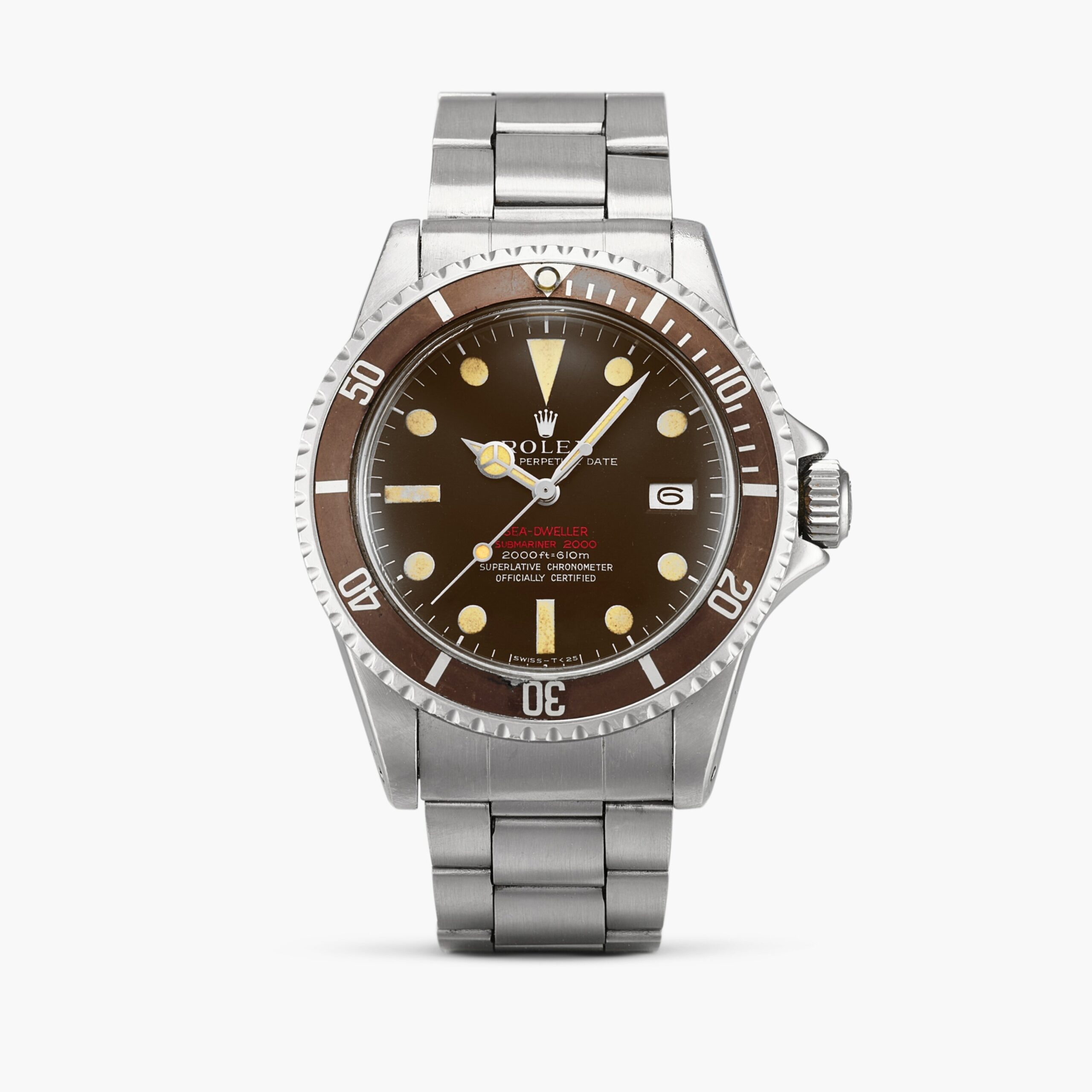
Early Sea-Dwellers carried two lines of red print on the dial (“SEA-DWELLER” and “SUBMARINER 2000” / “1665”), applied in a separate printing pass that Rolex eventually discontinued. Today, surviving Double Reds with original red text are the cornerstone of any serious vintage Sea-Dweller collection.
“Meters First” vs “Feet First” Submariners
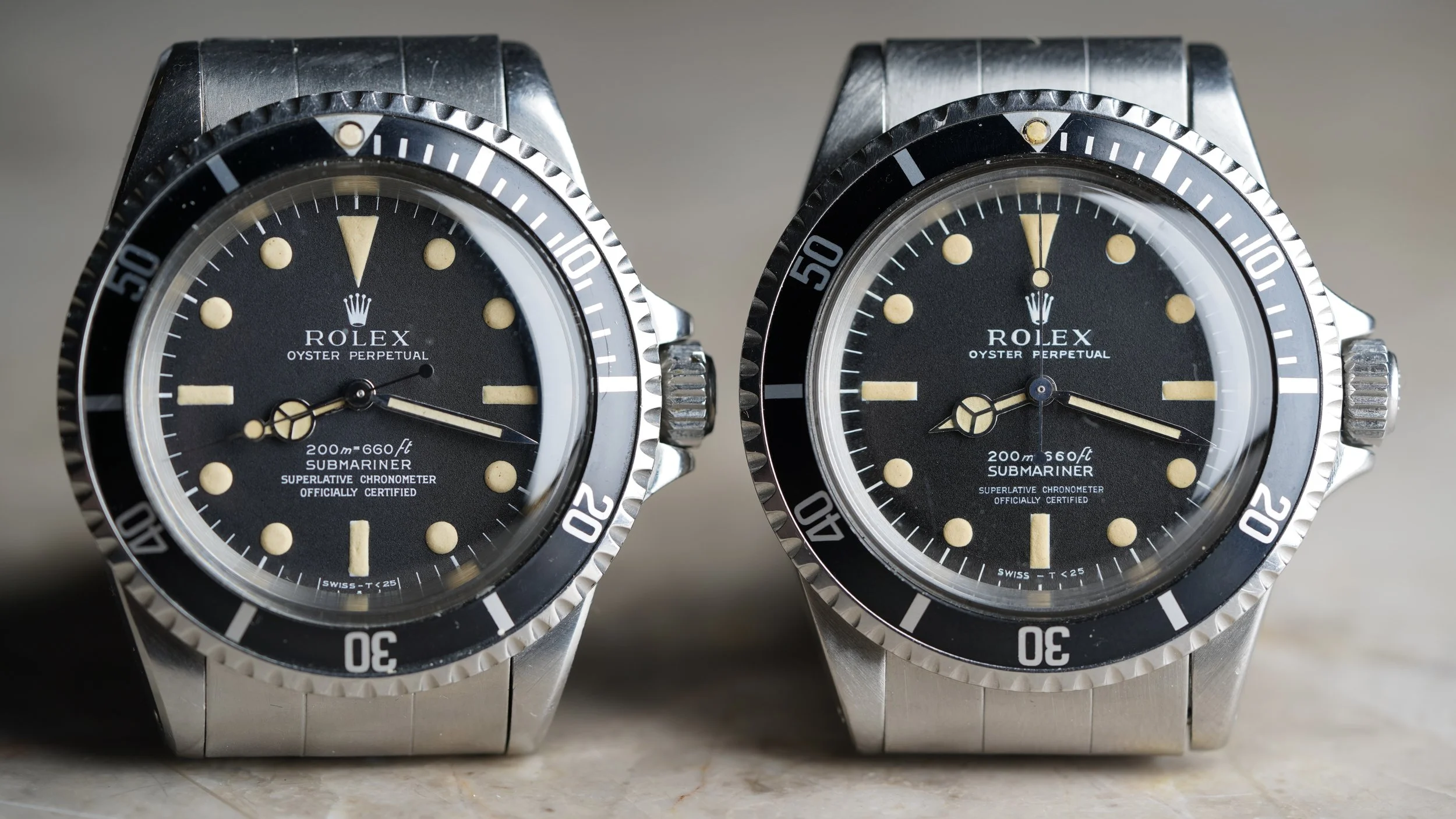
On vintage Submariners like the ref. 5512 and 5513, the depth-rating line on the dial could be printed with the metric figure first (“200m/660ft”) or the imperial figure first (“660ft/200m”). The earliest dials were Meters First. Later dials flipped the order. The two variants are mechanically identical Rolexes that, in equivalent condition, can trade at meaningfully different prices simply because one is rarer and earlier.
Gilt Explorer Dials
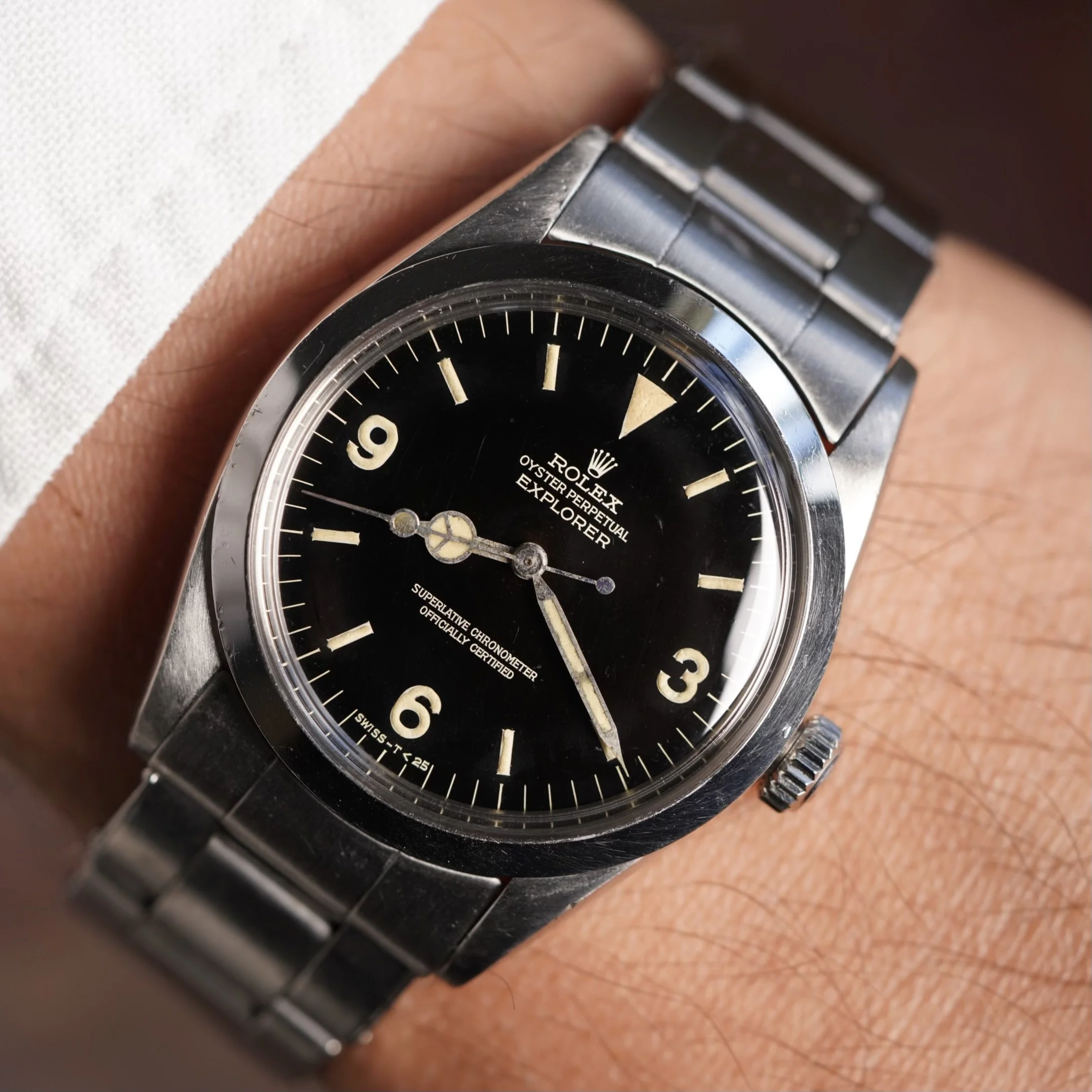
Before Rolex moved to matte dial production in the late 1960s, sport-model dials were “gilt”: gold-toned text and tracking printed onto a glossy black lacquer surface, often with a lacquer-over-print construction that aged dramatically. Gilt Explorer references from the 1950s and ’60s develop spidering, patina, and faded printing that make every dial genuinely one-of-a-kind.
“Error Punch” Variants
This is the catch-all term collectors use for factory punching, stamping, or text anomalies: a case-back stamp with a missing character, a guarantee paper with a misprinted reference, a dial with a letter out of alignment. They are scarce, often hard to authenticate, and command a story premium precisely because they are documented mistakes from a brand that hates admitting mistakes exist.
Modern Rolex Imperfections You Can Still Find Today
The vintage market is one thing. What surprises newer buyers is that the modern Rolex you take delivery of tomorrow will, if you look closely enough, almost certainly carry some small imperfection too.
Chromalight lume variance. Rolex’s proprietary blue-glowing lume, introduced around 2008, is a marketing centerpiece; the brand’s own brochure calls it “exceptionally bright and long-lasting.” In practice, owners of references like the Submariner Date 116610LN or the GMT-Master II 126710BLNR “Batman” regularly report that hands and hour plots glow slightly different shades of blue, or that plot fills look unevenly pooled under magnification. Most of this is within tolerance. Some of it isn’t. Bob’s Watches has a useful breakdown of why modern photo-luminescent lume behaves the way it does.
Cyclops and date-window misalignment. The cyclops lens is glued to the sapphire crystal at final assembly. A small offset is sometimes visible: the date numeral sitting a hair left, right, or low inside the magnified window. On a watch that bills itself as the world’s most legible date display, it is the kind of thing a perfectionist never stops noticing.
Rehaut engraving and laser-etched crown drift. Modern six-digit Rolexes carry “ROLEXROLEXROLEX” engraved around the inner bezel ring (the rehaut), plus a serial at 6 o’clock and a microscopic laser-etched crown in the crystal. Enthusiasts check whether the engraved “ROLEX” lines up with the hour markers and whether the laser crown sits dead-center at 6. A fraction of a degree of dial seating or crystal placement drift is enough to make them visibly off, and a small but real number of buyers reject watches over it at delivery.
Solid End Link (SEL) gaps. Modern sports bracelets are built with solid end links engineered to sit flush against the case. In practice, slight daylight between end link and case, or asymmetry between left and right sides, is one of the most common modern Rolex complaints. It is also, confusingly, one of the tells for a fake Rolex, which makes the line between “tolerance” and “red flag” genuinely fraught for new buyers.
Bracelet stretch and sag. Modern solid-link Oyster and Jubilee bracelets are dramatically better than the hollow-link bracelets of the five-digit era, but pins and sleeves still wear with daily use. A Jubilee-equipped GMT-Master II will develop a softer feel over years of wear; an Oyster that has been cleaned infrequently will sag unevenly.
Dial dust and printing bleeds. Even clean-room assembly cannot guarantee zero dust under the crystal. Forum threads are full of buyers who opened the box on a brand-new Rolex to find a microscopic fiber on the dial, or printing edges that, under loupe, look slightly soft. Rolex’s QC catches the obvious misses. The microscopic ones still ship.
Why Error Is Not the Opposite of Luxury
There is a particular strain of collector wisdom, usually delivered by someone who has been buying vintage watches for thirty years, that goes something like this: the imperfections are how you know it is real.
It sounds glib until you sit with it. A truly mass-produced object (a phone, a quartz watch, a $20 digital Casio) can be made essentially flawless because it is made essentially identically, every time, by machines, with no human judgement in the loop. That is what flawless means in industrial manufacturing: not that the object is better, but that the variance has been engineered out of it.
A Rolex is not that. A Rolex is a hand-assembled mechanical object, dial-printed, lume-applied, hand-set, hand-polished, and inspected by people whose job is to apply judgement, not to enforce a zero-defect standard. When you buy a new Submariner and notice a tiny offset on the cyclops or a faint asymmetry in the SEL gap, you are not looking at a failure of Rolex. You are looking at the evidence that an actual human being built the thing. The same evidence, in fact, that vintage collectors pay six- and seven-figure sums to find on a tropical Submariner or a Paul Newman dial.
The Japanese have a word for this. Wabi-sabi is the aesthetic principle that imperfection, impermanence, and incompleteness are themselves forms of beauty, and that a hand-thrown tea bowl is more valuable than a factory-pressed one precisely because it shows the maker’s hand. There is a related craft, kintsugi, in which broken pottery is repaired with gold-dusted lacquer, so that the flaw becomes the most luminous part of the object. Tropical dials, gilt patina, faded lume: these are, in a real sense, the kintsugi of horology. The watch lived a life. The life became the most valuable thing about it.
The commercial subtext is not subtle, and there is no reason to pretend otherwise. If you are evaluating a watch, ours or anyone else’s, and you find a small variance, the question to ask is not “is this a defect?” but “is this within the same texture of variance that the most coveted watches in the world also carry?” Almost always, the answer is yes.
What to Look For, What to Forgive, What to Send Back
Not every Rolex imperfection is romance. Some are just defects. Here is a rough framework for telling them apart.
Look for: the things that signal originality and life. Even tropical fading. Honest patina on lume plots. A dial that has aged as one. A bracelet that has stretched in proportion to its years. These are the things that, twenty years from now, will be the reasons your watch is worth more than an unopened example.
Forgive: the microscopic variances that exist on every hand-assembled watch on earth. A cyclops offset you can only see under a loupe. A Chromalight plot that glows a slightly different blue than its neighbor. A rehaut engraving a fraction of a degree off true. An SEL gap measured in tenths of a millimeter. None of these are flaws in any meaningful sense; they are the fingerprint of how the watch was made.
Send back: anything functional, anything visible at arm’s length, anything that compromises water resistance or timekeeping, anything that suggests the watch was damaged rather than assembled. A misaligned bezel that won’t hold its setting. A date that doesn’t snap cleanly into the cyclops window. Dust or fibers large enough to see without magnification. A bracelet link so loose the watch rattles on the wrist.
If you want a deeper reference for where the line sits between acceptable variance and an actual problem, our how to spot a fake Rolex guide walks through the same checklist that authenticators use. Many of the same tells that distinguish a genuine Rolex from a counterfeit are the tells that distinguish a well-assembled Rolex from one that should go back to the AD. The Rolex reference number guide is also worth bookmarking, since the period and configuration coded into a reference number are usually the first clue to whether an apparent “imperfection” is original or the work of a later service.
And if you want a sense of how far a small factory quirk can go, look again at that 1968 Daytona. It left Geneva as a slow-selling dial variant on a watch the dealer community had largely written off. It sold at Phillips in 2017 for the price of a Manhattan penthouse. The imperfection wasn’t the opposite of value. It was the source of it.
Even Rolex makes mistakes. Sometimes, those mistakes are the best Rolexes the company ever built.
FAQ: Rolex Imperfections
Are Rolex imperfections common?
Yes, in the sense that any hand-assembled mechanical watch carries small variances. Rolex produces over a million watches a year to extraordinarily tight tolerances, but microscopic deviations in lume color, cyclops alignment, rehaut engraving, and SEL fit are well-documented on enthusiast forums. Most are within the brand’s accepted tolerance band.
What is a tropical dial?
A tropical dial is a black Rolex dial that has faded to brown over decades of UV, heat, and humidity exposure. Even, attractive tropical fading is prized by collectors because it is unrepeatable and cannot be convincingly faked; each tropical dial is a one-of-a-kind aging artifact.
Why is the Paul Newman Daytona so valuable?
The Paul Newman Daytona ref. 6239 carried an “exotic” dial that was commercially unpopular when launched in the late 1960s. After Paul Newman was photographed wearing one, the dial nobody wanted became the dial everyone wanted. His personal watch sold at Phillips in 2017 for $17,752,500.
Do vintage Rolex imperfections increase value?
Often, yes. Factory-original quirks like tropical dials, gilt patina, “Meters First” printing, and red-text variants are documented and named by collectors, and they frequently command premiums over equivalent standard-dial examples, provided the imperfection is honest, original, and attractive.
Should I return a new Rolex over a small imperfection?
It depends. Microscopic variances visible only under magnification (slight cyclops offset, minor Chromalight color drift, fractional SEL gap) are normal for hand-assembled watches. Functional issues, visible defects, water-resistance concerns, or anything that affects timekeeping should be returned to the authorized dealer under warranty.
FAQPage JSON-LD
